Bacteria

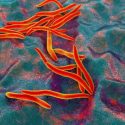
Mycobacterium tuberculosis bacteria.
#Bacteria #TB #University of Bath

Research opens up new avenue for tuberculosis drug discovery

A new study has highlighted two new potential families of drug molecules that could open the door to new treatments for tuberculosis (TB).  TB, caused by the bacterium Mycobacterium TB, is the second largest infectious killer globally after Covid-19 and causes 1.3 million deaths annually. … Read More

#News

Close up of vaccine syringe
#Bacteria #Immunology / Virology & Vaccines #University of Oxford #Viral vectors

Gene-based vaccine shows promise in early-stage trial

Trial results have revealed encouraging results for a new vaccine targeting group B meningococcus (MenB) and established that a gene-based vaccine platform can induce protective antibody responses against bacteria.  The investigational vaccine, ChAdOx1 MenB.1, developed by researchers at the University of Oxford, was shown to be safe… Read More

#News #Trending News

E coli bacteria
#Antibiotic resistance #Antimicrobial resistance (AMR) #Bacteria #Genetics / genomics

Scientists displace antibiotic resistance genes from bacteria

Birmingham scientists have identified essential genetic code for a method called plasmid curing, which aims to ‘displace’ antibiotic resistance genes from bacteria.   Plasmids play a crucial role in allowing bacteria to share beneficial genes rapidly in a changing environment, most concerningly when they carry genes conferring resistance… Read More

#News

E coli bacteria
#Antivirulence #Bacteria #Gut microbiome #Mouse models #Preclinical development #University of Glasgow

Early studies identify a new treatment for E coli infections

Scientists have taken an important step toward the development of a potential new treatment for treating Shiga toxin-producing E coli (STEC), the bacteria associated with severe food poisoning.  The findings – led by the University of Glasgow and published in Antimicrobials and… Read More

#News

Patient taking antibiotics
#Antibiotic resistance #Antibiotics #Antimicrobials #Bacteria #FDA #GSK #Urinary

New class of oral antibiotics for uUTIs gets FDA green light

The US Food and Drug Administration (FDA) has approved Blujepa (gepotidacin) for the treatment of female adults (≥40 kg) and paediatric patients (≥12 years, ≥40kg) with uncomplicated urinary tract infections (uUTIs).  It is approved to treat infections caused by the following susceptible microorganisms: Escherichia coli, Klebsiella pneumoniae, Citrobacter freundii complex,… Read More

#News #Regulatory

DNA sequencing
#Antibiotics #Bacteria #DNA #Gene sequencing #Infectious diseases #MHRA

DNA sequencing diagnoses bacterial infections faster

Scientists have developed a DNA sequencing approach that can be implemented in hospitals to diagnose bacterial infections faster and more accurately.  Developed by a UK team from Barts Health NHS Trust and the Medicines and Healthcare products Regulatory Agency (MHRA), the service is designed to help doctors… Read More

#Editor's Choice #News

#Antimicrobial resistance (AMR) #Bacteria #Funding #Gram-negative bacteria #Infex Therapeutics

£1m grant for drug targeting multi-drug-resistant bacteria

Infex Therapeutics, in collaboration with Justus-Liebig-University Giessen (JLU), Germany, has been awarded a £1 million grant from PACE (Pathways to Antimicrobial Clinical Efficacy).  The company plans to develop a first-in-class BamA inhibitor targeting multi-drug-resistant (MDR) Gram-negative pathogens.  BamA inhibitors are an entirely new class of antimicrobial drug designed to target… Read More

#Business & Investment #News

Thermo Fisher Scientific
#Antimicrobial resistance (AMR) #Antimicrobials #Bacteria #Webinar

Structural advances in multidrug-resistant Acinetobacter baumannii

In a recent DDW event, sponsored by Thermo Fisher Scientific, Daniel J Klein, Senior Director of Protein and Structural Chemistry at Merck and Co discussed the current advancements taking place in antibiotic drug discovery. Klein spoke about how structural biology tools such as cryoelectron microscopy and X-ray crystallography are being used… Read More

#Exclusive Content

Hydrogel
#Antibiotic resistance #Antibiotics #Antimicrobial resistance (AMR) #Bacteria #Chalmers University of Technology #Hydrogel

Hydrogel enhances antibiotics’ effect against resistant bacteria

New research has shown that resistant bacteria can regain susceptibility to antibiotics when the treatment is combined with a material equipped with antibacterial peptides. The study, performed in a laboratory environment, shows that antibiotics can achieve a 64-fold increase in bactericidal effect when used together with… Read More

#News #Trending News

Destruction of a bacterium by silver nanoparticles.
#Antibiotic resistance #Antimicrobial resistance (AMR) #Bacteria #EVŌQ Nano #Nanopharmaceutics

Silver nanoparticle destroys bacteria from the inside

New data indicates EVŌQ Nano’s nanoparticle EVQ-218 could combat the world’s worst superbugs without triggering antimicrobial resistance (AMR). Bacteria’s ability to form biofilms is a key factor in their resistance to antibiotics. Biofilms are protective layers that shield bacteria from therapeutic interventions and… Read More

#Editor's Choice #News

Bacteria in Petri dishes
#Antibiotic resistance #Antibiotics #Antimicrobial resistance (AMR) #Bacteria #The University of Manchester

New understanding of bacteria mutation rates could combat AMR

Scientists have discovered a way to control mutation rates in bacteria, introducing the possibility of new strategies to combat antimicrobial resistance (AMR). The researchers used high-performance computing to simulate more than 8,000 years of bacterial evolution, allowing scientists to predict mechanisms that control mutation rates. Read More

#Editor's Choice #News

Fusobacterium
#Bacteria #Guy’s and St Thomas' #Head and neck cancer #King's College London #Oncology

Bacteria destroys head and neck cancer tumours

Researchers at Guy’s and St Thomas’, and King’s College London in the UK have found that a bacteria is toxic for head and neck cancer and could lead to better treatments for patients. Fusobacterium is usually associated with the progression of bowel cancer. However, new research… Read More

#Cancer Research #Editor's Choice #News

Petri dish used for bacterial research
#Bacteria #Endothelial dysfunction #Preclinical investigations #Sepsis #University of Queensland

New drug could prevent sepsis-related organ failure

A new drug could prevent sepsis-related organ failure and death by restoring the health of a patient’s blood vessels. Researchers from The University of Queensland and the Queensland Children’s Hospital (QCH) have successfully tested the first-in-class drug in mice. Dr Mark Coulthard from UQ… Read More

#News

Bacteria
#Antibiotics #Antimicrobial resistance (AMR) #Bacteria #Bacteriophage #ETH Zurich

Swiss scientists identify a virus that kills dormant bacteria

Researchers have found a virus that kills dormant bacteria, a discovery that could help to combat infections that can’t be treated with antibiotics. For the first time, ETH Zurich researchers in Switzerland have isolated a bacteriophage from rotting plant material that can attack and kill bacteria… Read More

#Editor's Choice #News

Antibiotics
#Antibiotic resistance #Antibiotics #Antimicrobial resistance (AMR) #Bacteria #Drug discovery

Antimicrobial resistance: Tackling the ‘silent pandemic’

Diana Spencer speaks to Christopher Reid, Professor of Biological and Biomedical Sciences at Bryant University, in Rhode Island, US, to understand the issue of antimicrobial resistance, why there are so few new antibiotics in development and where the drug discovery opportunities can be found. The scale of the crisis In… Read More

#Exclusive Content

Petri dish used for bacterial research
#Antibiotic resistance #Antibiotics #Antimicrobial resistance (AMR) #Bacteria

Powerful new antibiotic isolated from microbial ‘dark matter’

New powerful antibiotic Clovibactin seems capable of combating harmful bacteria, and even multi-resistant ‘superbugs’, in a way that makes it more difficult for bacteria to develop resistance against it.   Researchers from Utrecht University (Netherlands), Bonn University (Germany), the German Center for Infection Research (DZIF), Northeastern University of… Read More

#News #Trending News