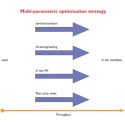
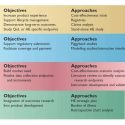
Hit to lead and lead to candidate optimisation using multi-parametric principles By Dr Anthony D. Baxter and Dr Peter M. Lockey As the numbers of potential target proteins become available for pharmaceutical companies of all sizes, the drive towards more cost-effective drug discovery assumes greater significance. It is a truism… Read More
Data Mining in the pharmaceutical industry By Dr Robert D. Small and Herbert A. Edelstein A research-based pharmaceutical company is a data accumulating wonder. More than in any other industry, success is predicated on the collection, processing and exploitation of that data. This is not always recognised and often not… Read More
Evaluating future drug candidates and their manufacture together By Professor Peter Dunnill Classically, evaluating a candidate drug has preceded evaluation of the process for making it. The late rush to process development worked reasonably well with simple chemical pharmaceuticals. With complex biopharmaceuticals, a new approach is needed. One now being… Read More
Chemogenomics - A gene family approach to parallel drug discovery By Dr Paul R. Caron, Dr Michael D. Mullican, Dr Robert D. Mashal, Dr Keith P. Wilson, Dr Michael S. Su and Dr Mark A. Murcko Currently available drugs only target around 500 different proteins (4). Recent reports from efforts… Read More
The lab on a chip and its impact on drug discovery by Dr Simon Cowen and Dr Coulton Legge Few technology developments have had as profound an effect on society as the invention of the microchip integrated circuit in the 1960s. Since then, the power of electronic circuits has increased… Read More
Why pharmaceutical companies should teach scientists to be entrepreneurs By Dr Jeffrey P. Kiplinger Conventional wisdom says that big employers do not want anything to do with entrepreneurs as employees. The last thing a human resources director wants to see on a resume is that a candidate started a business… Read More
The Impact of Genomics on Regulation By Dr Steve Arlington, Dr Tim Peakman, Adriana Salvatore and Jonathan Peachey Advances in science and technology are enabling us to understand physiology and pathology at a totally new level; to define, subtype and track diseases much more accurately; and to treat patients far… Read More
New Developments in Analgesia By Dr Susan Boyce, Dr Zahid Ali and Dr Raymond G. Hill Novel therapies for pain and headache are major medical needs and constitute a continued opportunity. Novel treatments are likely to arise from a better understanding of both the pathophysiology of clinical pain conditions and… Read More
Health economic considerations for early drug discovery By Dr Ann-Marie Craig and Dr Lisa Kennedy The use of health economics in early phase development, while not an exact science, can, when conjoined with clinical evidence, be a very valuable information tool enabling companies to identify whether there is a market… Read More
Surrogate Endpoints In Cancer Trials By Professor Karol Sikora Over the next 20 years systematic programmes of cancer risk assessment will be established and cancer-preventive drugs will be developed. The ability to prevent cancer will dramatically increase the number of people who will need to regularly attend clinics. This article… Read More
Protein Arrays - New technology for the proteomics era By Dr Jeffrey P. Kiplinger The study of the human proteome will drive drug discovery in coming years; although how, when, and in what direction are a little uncertain at present. To build understanding of the role of the human protein… Read More
Unrealised wealth in the avalanche of science By Dr Benjamin P. Chen The human genome information complemented with high throughput screening, proteomics and molecular structure analysis has significantly increased the speed at which potential drug leads are identified. The Pandora's box of intellectual properties opened as a result is beyond… Read More
Outsourcing life science informatics solutions By Dr Steve Gardner The life science industry depends on information gathered from new technologies for productivity and competitive advantage in the R&D process. As more information is gathered and the systems become more complex, building and maintaining data management solutions that support rapid and… Read More
By Dr Doros Platika As the population ages, the scientific and medical communities are working to solve the challenges this changing demographic will place on society. Companies involved in the promising field of regenerative medicine are now on the cutting edge as it strives to promote longevity without disability. Regenerative… Read More
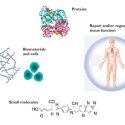
Protein Therapeutics - New ladders up the fruit tree By Dr Richard AG Smith Therapeutic proteins are often regarded as too technologically demanding, too costly, too restricted in routes or duration of administration or - in an era of massive opportunity provided by high throughput screening, combinatorial chemistry and genomics… Read More
Biologically Relevant Chemistry By Dr Stephen A. Hill A large proportion of R&D expenditure relates to the investigation of compounds which ultimately fail to reach the market as useful medicines. We discuss why early drug discovery - using high throughput, automated in vitro and in silico methods, must become the… Read More