Stop settling for the proxy – Why stability tests for biologics should measure intermolecular interactions directly
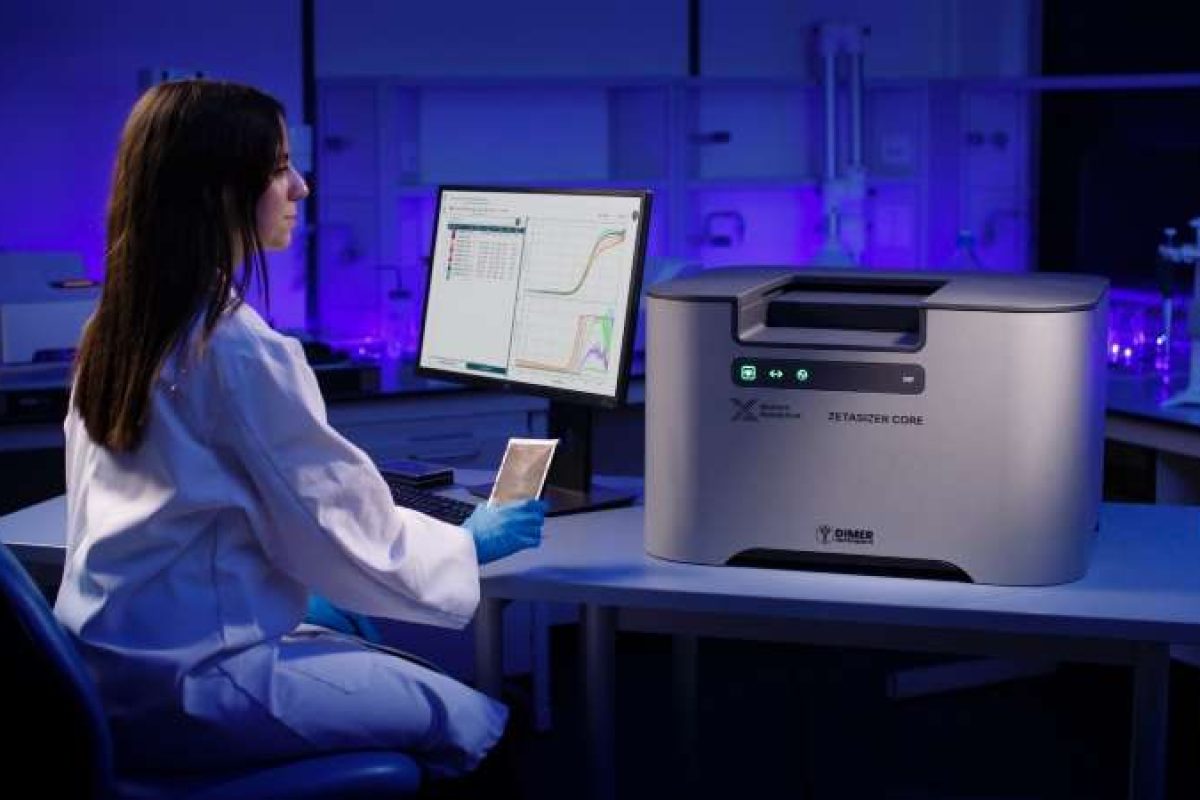
In this advertorial, Dr John Stenson from Malvern Panalytical explains why we need to move away from using ‘SLS mode’ on DLS instruments to determine B22 stability values for biologics.
Reliable stability data: A growing need
Stability testing for biologics is undergoing something of a revolution, with the introduction of standard well-plate-based formats making it possible to run high-throughput stability tests across discovery and early development. Having data on aggregation potential, colloidal instability and thermal sensitivity earlier in the pipeline allows companies to make informed choices while the candidate pool is still broad – but that data is only useful if it can be relied upon. Otherwise, we may just be replacing the risk of expending time and money on an unsuitable candidate by the equally undesirable risk of dismissing a good candidate on the basis of flawed or incomplete data.
So, as we move towards large-scale, early-stage stability screening, we need to take a close look at the quality of the data that those methods are giving us. And this is where one metric – the second virial coefficient – is worth discussing.
The problem with how B22 is measured
The second virial coefficient B22 is a metric indicating the net intermolecular forces between two proteins in dilute solution. B22 is valuable for understanding the risk of self-association in different buffers, with positive values indicating solubility and colloidal stability, and negative values indicating the risk of aggregation or precipitation. It’s possible to use the diffusion interaction parameter kD as a proxy for colloidal stability when ranking candidates, but reliance on kD as a ranking tool to evaluate colloidal stability can obscure the true ranking due to the contributions of both kinetic and thermodynamic factors. In contrast, B22 provides an absolute thermodynamic measure of colloidal stability and can be used as a low concentration predictor of high concentration effects, but existing systems fail to deliver high-quality measurements.
B22 values are determined using static light scattering (SLS), by plotting the intensity of light scattered against a set of solutions of increasing concentration, and by how much the plot deviates from linearity. However, the reliability of the values obtained depends on the equipment used to make the measurement. Dedicated SLS platforms are available, but these have a reputation as being for experts only. This means that it is commonplace to instead use instruments intended for dynamic light scattering (DLS), but with the sensor operating in ‘SLS mode’.
However, there’s a problem with this approach, because the highly sensitive single-photon sensors in DLS systems become saturated at higher photon fluxes, meaning that the detector response is not linear at higher concentrations (Figure 1). This means that samples must be interleaved with toluene standards, and the results algorithmically corrected back into linearity. As a result, the workflow is complex and the results are sensitive to the smallest changes in setup – even to the extent of needing to use the same cuvette in the same orientation in successive runs.
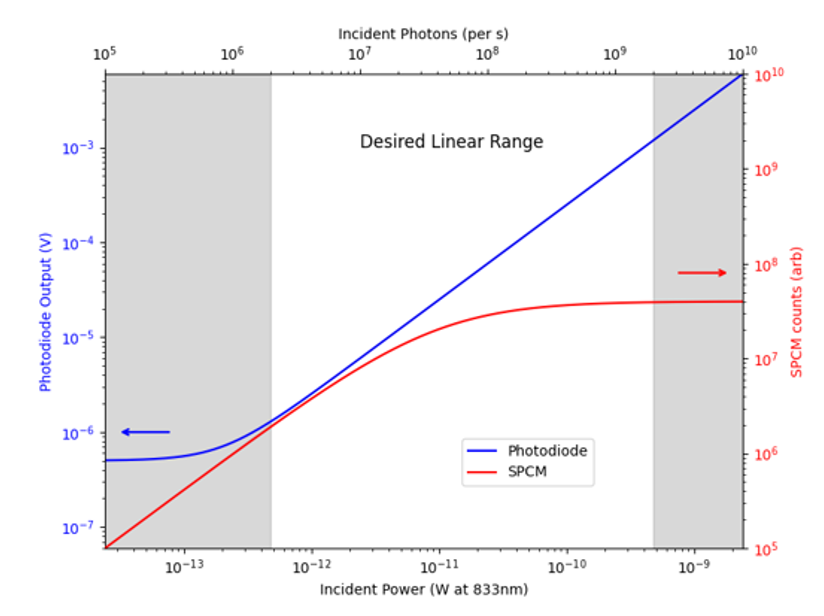
Figure 1: The response of single-photon sensors (SPCM) used in DLS instruments (red line) deviates from linearity at high light intensity (corresponding to high analyte concentration), unlike photodiodes used in instruments with dedicated SLS optics (blue line), which maintain a linear response across the range.
Improving data quality, simplifying calibration
As pharma moves towards earlier-stage stability testing, it’s therefore important to take a fresh look at using dedicated SLS optics for determining B22, while also making the equipment suitable for high-throughput workflows. Doing this would instantly resolve issues with data quality, because it would allow photodiodes with linear responses over a wide range to be used, avoiding the need for additional standards and algorithmic data fixes. This would not only dramatically speed up the whole process, but would allow it to be completely automated in the software, eliminating the need for labour-intensive manual operations, and reducing the level of expertise needed to acquire a measurement.
So when can we expect to see this shift to more trustworthy B22 data within a streamlined stability workflow? The answer is it’s already happening, with the launch of the Zetasizer Core system from Malvern Panalytical – a system that’s been designed with early-stage biologics workflows in mind. As well as offering dedicated linear SLS optics for determination of high-quality B22data, it simultaneously makes DLS and differential scanning fluorimetry (DSF) measurements, and accepts standard 96-, 384- and 1536-well plates for high-throughput screening.
Integrating data acquisition in this way has another benefit, because it allows side-by-side acquisition of independent B22 and kDmeasurements from the same sample in the same wells, making it possible to acquire a suite of interaction data that was previously inaccessible (Figure 2).
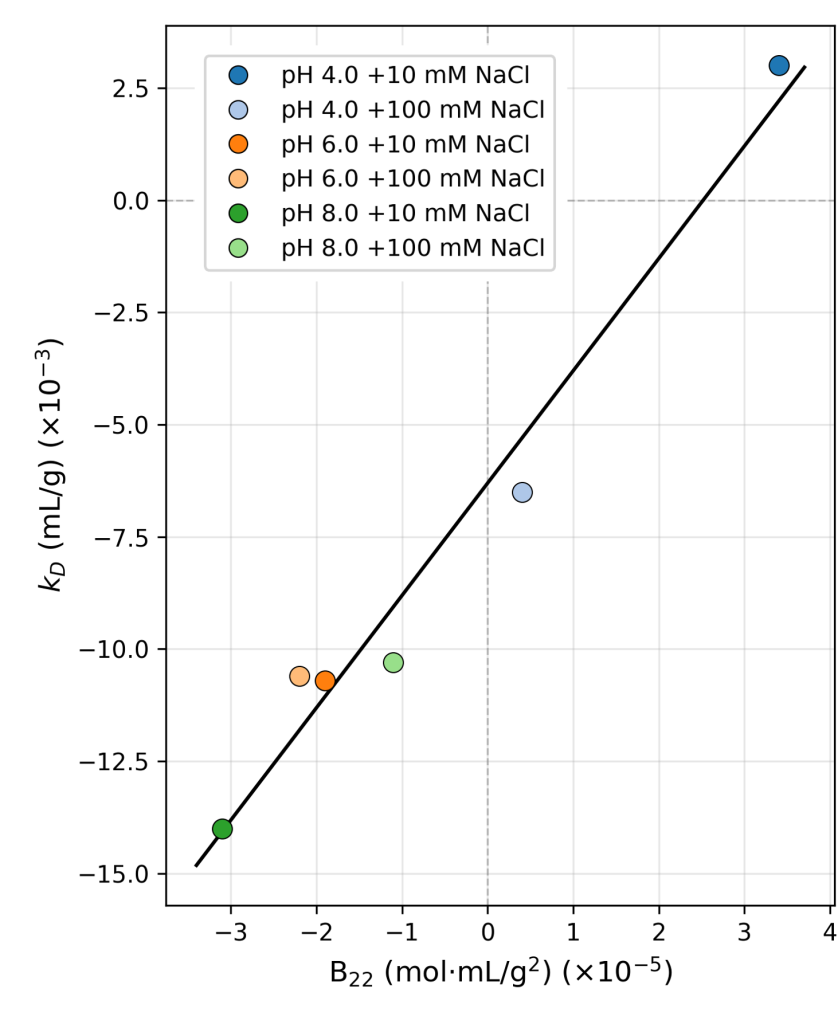
Figure 2: Using dedicated linear SLS optics on the Zetasizer Core, B22 values for proteins can be rapidly and reliably acquired, and compared against independently determined kD values to uncover nuances that would otherwise have been missed. In this case, at pH 4.0 +100 mM NaCl, kD is negative, indicating an attractive interaction, whereas the B22 is positive, correctly suggesting a repulsive interaction.
With the launch of the Zetasizer Core, we think we’re setting a new trend in stability measurement for biologics, by providing instrumentation that maximises data quality while minimising time to results, without requiring years of experience to run the equipment. As a result, we can take the risk out of stability testing, and so help pharma companies accelerate the development of effective biologics.
Find out more about the Zetasizer Core system on the Malvern Panalytical website.
About the author
Dr John Stenson is a Product Manager in the Biophysical Characterization group at Malvern Panalytical, based in the company’s UK headquarters. He holds a PhD in Biochemical Engineering from the University of Birmingham and completed postdoctoral research at the University of Cape Town, where his work focused on the downstream processing of biopharmaceuticals.