
From AI design to experimental validation: The next frontier in antibody discovery

This article is sponsored by GenScript.
Integration of artificial intelligence (AI) into antibody drug discovery is occurring in phases, as AI models mature, and developers seek to compress discovery and development timelines. While increasingly iterative and feedback-driven approaches to AI-driven antibody discovery have made the process more efficient, they have also heightened the demand for structured, multi-parametric experimental data needed to fuel the discovery process.
Fast-evolving computational biology tools and AI models are transforming antibody discovery and development workflows, with the aim of accelerating therapeutic pipelines and broadening access to novel treatments.
For instance, AI models capable of predicting an antibody’s three-dimensional structure and antibody-antigen binding interactions from the amino acid sequence now enable the design of antibody candidates in silico. Structure-prediction models, which first emerged in the early 2020s, addressed a pervasive challenge in protein research: relating the amino-acid sequence encoding an antibody to its structure and function.
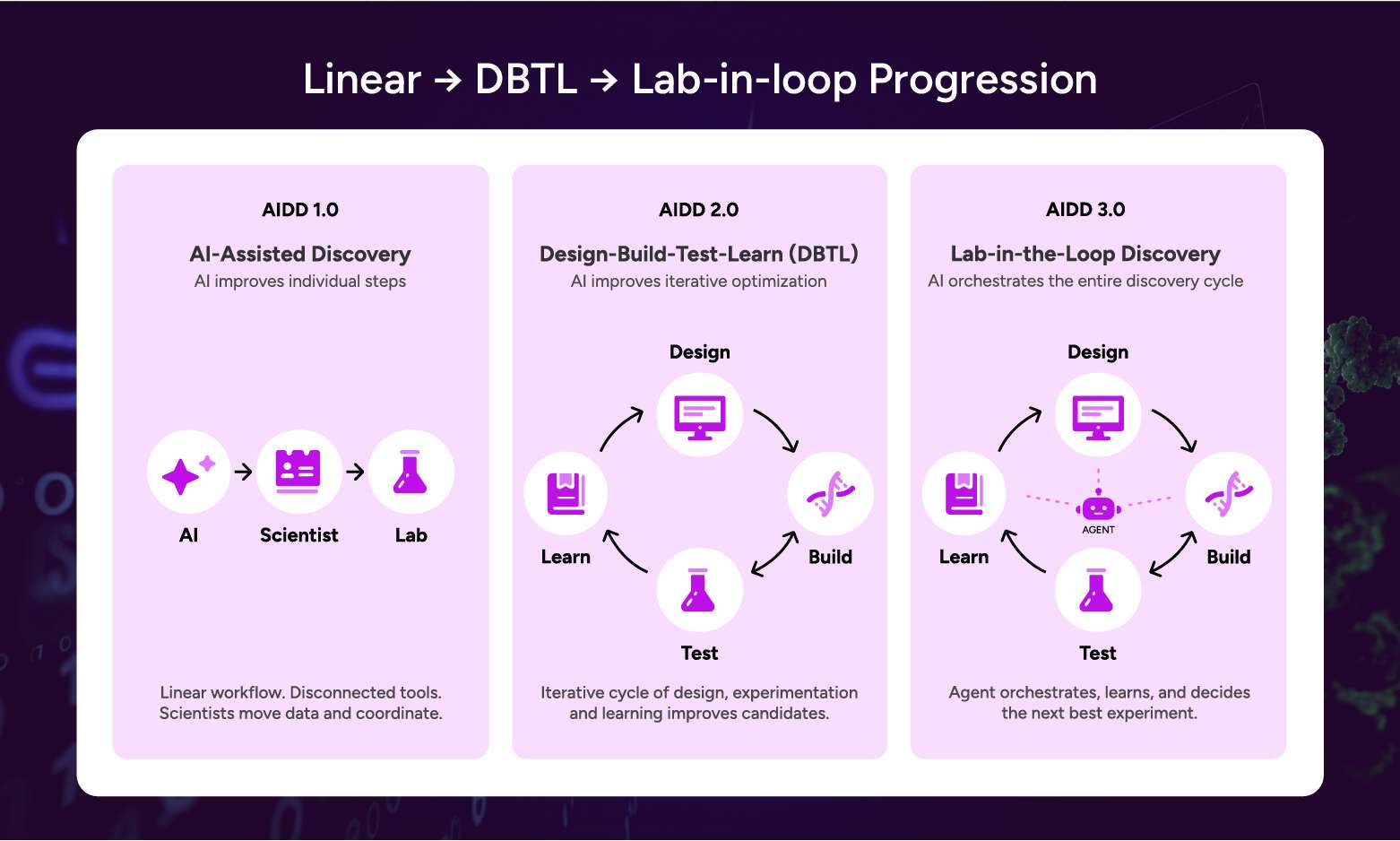
Emerging AI applications address additional discovery-stage pain points. Before time-intensive experimental screening, developers struggle to predict the diversity of factors that can disqualify antibodies as lead candidates, including off-target toxicity, immunogenicity, protein aggregation, thermoinstability, chemical instability or viscosity at high concentrations. Some of these factors can be predicted by AI-based structure modeling and addressed with minor adjustments to an antibody sequence.
Discover how to close the AI drug discovery validation gap. Read the eBook.